



As the readers of our magazine are well aware, the Mountain Hunters Club has set several ambitious goals, which were announced a year ago as projects of the CMH. You can read what has been completed and what is planned for the near future in our material.
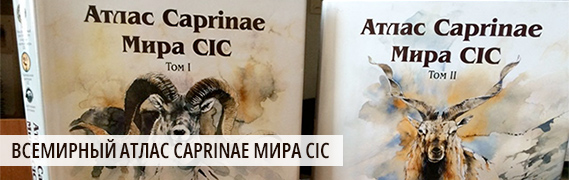
One of the first projects was the publication in Russian of the two-volume book "Mountain Ungulates of the World" by Gerhard Damm and Nicholas Franco. Two multi-page folios with color illustrations, printed on coated paper, have already seen the light. The successful completion of this project raised the prestige of the club, and the number of its members began to grow even faster. It only seems that the publication of such a two-volume book is a common event. Translation, scientific and literary editing of the text, compliance with all legal formalities required serious expenses and financial and intangible resources.
Another project of the club is the collection of biological material for genetic research. It’s an indefinite project. There is a serious laboratory base for such studies, but scientists are simply not able to get the material for analysis on their own. Expeditions to collect it are expensive. But it is not a burdensome task for a hunter to take a few samples from the trophy. But you have to know that it is impossible to get a serious result that will allow to talk about the taxonomy of mountain ungulates with the highest accuracy soon. It takes years that's why I repeat that this project is indefinite. But we can't say so about the new projects of the club, announced by its president at the general New Year's meeting of the CMH.
One of them is the organization of monitoring of the Putoransky subspecies of the snow sheep (Ovis nivicola borealis) on the territory of the Putoransky gas processing Plant and adjacent areas. This project is designed for five years – from 2017 to 2021. The work will be financed not only from the budget, but also at the expense of the Mountain Hunting Development.
Edward Bendersky has already received a proposal from the Federal State Budgetary Institution "United Directorate of Taimyr Nature Reserves" on cooperation with a phased calculation of funding, and most of the budget is planned to be covered by extra-budgetary funding.
We should explain why we devoted so much time to that project.
The Putoran subspecies of the snow sheep is a rare subspecies with an isolated habitat. It is listed in the Red Book of Rare species of the Russian Federation and the Red Book of the Krasnoyarsk Territory. The last detailed studies devoted to that theme were conducted 30 years ago. Those materials compiled in 1989 and formed the basis of the project on the organization of the State Nature Reserve "Putoransky". In 1995-1996 and in 2002-2003, there were only fragmentary aerial surveys of individual areas of the sheep' habitat and selective ground observations that did not give a complete picture of the total number and distribution of the silver horn within the Putorana plateau. The total number of animals was estimated at 5-5. 5K individuals and 6-6. 5K animals, respectively. Such high estimates of the number of snow sheep need to be supported by the results of modern and more large-scale studies with the usage of aviation, satellite telemetry and other remote observation methods. The number of sheep on the territory of this reserve currently does not exceed 800 individuals according to the results of ground work and a fragmentary aerial survey of the territory of the Putoransky Reserve in 2013-2016.
The vastness and inaccessibility of the habitat of the snow sheep, the secrecy of this animal and the complexity of its visual detection on the rocky slopes of the mountains – all this requires a significant amount of detailed research at different points of the Putorana plateau with a large expenditure of time and money.
It is impossible for the staff of the institution to cover many key areas of the population of this animal due to the lack of funding. There is no objective information about the number and distribution of the species in the Putoransky Reserve and its protected zone, that does not allow to make an objective conclusion about the state of the population of the snow sheep as a whole and to give an opinion about measures for its protection.
The regulatory and legal support of the state and financial support of interested parties, one of which is the CMH, will allow to collect mass and representative material about the current state of the Putoran snow sheep population on the vast territory of the Putoran Reserve and adjacent areas and will become a significant contribution to the study of rare species of Russia, which is undoubtedly the Putoran snow sheep.
As part of the program of comprehensive studies of the current state of the snow sheep population, it is planned to:
- To perform a retrospective analysis of the population distribution in the reserve and its protected area;
- to built the foundations for population monitoring using remote methods;
- to give a differentiated characteristic of the habitat, to identify a list of limiting factors and the degree of their influence;
- conduct an inventory of the population's habitats;
- to account the number of bighorns and determine the sex and age structure by habitat centers;
- to study the relationships in the "snow sheep-large predators" system within the distribution area of the population;
- to study nutrition, feed resources and their availability;
- to conduct a study of the genetic polymorphism of the bighorn population;
- to conduct biochemical studies and study the health indicators of several individuals;
- to develop the conservation strategy of the Putoran subspecies.
The project is ambitious, as it has to be as the project of the Club of Mountain Hunters Club. But there are much more ambitious projects in the club's plans! At the New Year's party of the Club, its president Eduard Bendersky drew the attention of the audience to the fact that there are many examples in the world when the introduction and reintroduction, helped to recreate or create completely new animal populations in territories suitable for their habitat. Such projects have been successfully implemented in Europe (Croatia, Macedonia, Austria, Switzerland), where the settlement of mountain ungulates made some of the countries into hunting meccas. We know about such samples in the USA, Australia, and New Zealand. Our country has a huge potential, but nobody has been engaged in such work until now, or has been engaged in it insufficiently effectively. We talk about Ural. The issue of the introduction of the Siberian ibex into the Verkhoyansky Ridge in Yakutia was studied long time ago. The most realistic project in the near future will be to create a population of chamois in the Crimea. But we’ll involve into it only after a thorough study of this issue and appropriate approvals.
It's possible that some of the readers will find such plans unrealistic but we are already used to not believe in the possibility of grandiose achievements. Only time will tell who is right.